Campervan Electrics

You've just bought a van and want to convert it into a camper van.  One of the main things you will want to do is think in advance about power and how to install electrics into your campervan.

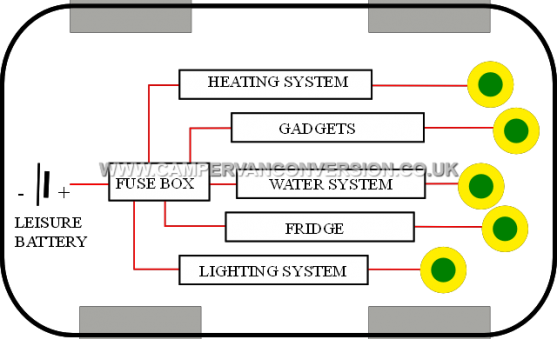
There are a number of issues relating to electrics in a van conversion project.  If you have any plans whatsoever to sit in your campervan for an evening with the lights on, music playing, heater fan spinning away, then I suggest you fit a second battery.  This is probably the key electrics issue and therefore the article below specifically considers how you go about installing a second or "leisure" battery. 

Installing a Second / Leisure Battery in a Campervan

Introduction

If you don't install a second battery into your campervan to run key electrical items off, then either you will at some point run your van battery down to the point where you can't start the engine in the morning; or you will constantly be living in fear of using up too much electricity and will end up reading by the light of head-torch rather than risk needing a jump start the next day.

Van Battery Types

There are two types of vehicle battery - starter batteries and 'second' batteries (second batteries are also known as 'leisure' batteries and 'deep cycle' batteries). Starter batteries are designed to supply large amounts of power in short bursts - specifically to start the engine; starter batteries are not designed to get regularly run down - they function best when the engine starts first time and the alternator then tops them straight back up.

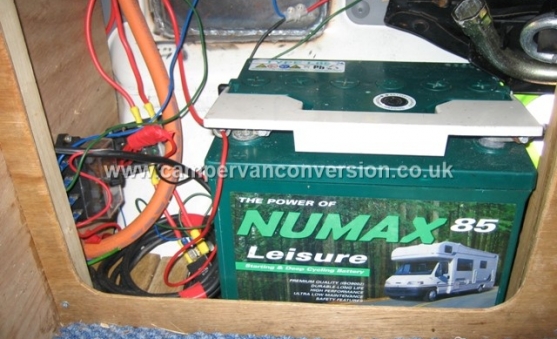
Leisure BatteryLeisure batteries on the other hand are designed to function well when you run them almost completely down time after time - this is why they are called 'deep-cycle'.

Leisure batteries can in an emergency be used to start an engine, but they are primarily designed for extended use by lower power users - for instance by the sorts of appliance you find in a campervan or in a yacht.

So, you've presumably already got a starter battery in your campervan - now you need to add a second 'deep-cycle' battery. Your starter battery will be used to start the engine, your second battery will be used to power your appliances (water pump, heater fan, sterio, lights, TV, laptop, electric blanket, etc, etc) while you're parked up. In this way you can happily forget about how much power you're using and know that you'll still be able to start the engine after your long weekend at the beach. Of course you do still need a way of re-charging the leisure battery, so the ideal arrangement involves a system where your van's alternator charges both batteries while you're driving, but only your leisure battery is drawn on whenever the engine isn't running.  Just as important, only the starter battery should be drawn on when the engine is started (as the massive current needed to start the engine needs a really thick cable which you're unlikely to have going to your leisure battery).

Installing a Leisure Battery

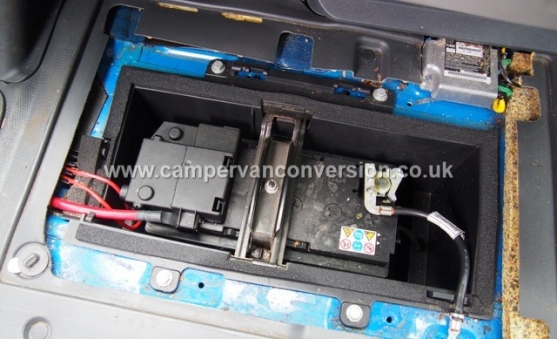
Firstly, find a good place to store your second battery.  First choice is in the engine compartment but there often just isn't space.  Ideally you want to have the leisure battery as close as possible to the starter battery and alternator (making charging more efficient and cutting down on cable routing), and you also need to think of safety - batteries give out hydrogen when they charge and can potentially leak acid and even blow up.  So if you need to site the battery inside the van due to lack of space in the engine compartment, you'll need to create a boxed in area keeping the battery isolated from pretty much everything else.  In particular, do NOT put the battery right next to the gas! - definately asking for trouble!  Most batteries come with a tube that allows you to vent hydrogen produced during charging to the outside of the vehicle.  You need to fix the battery firmly in place too, and for this an old battery tray from a scrap yard can be ideal - get a hacksaw and some self tapping screws or bolts and be inventive!

Battery Wiring and Split Charge Relays

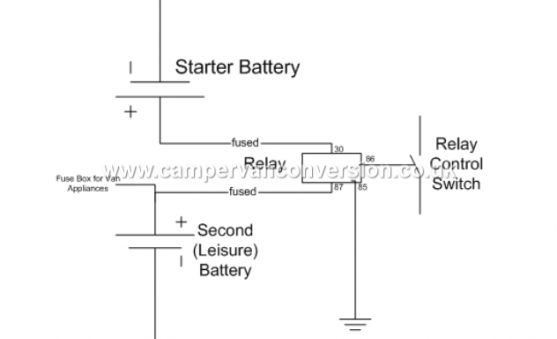
OK, the wiring for this is actually fairly straightforward, but can be a bit daunting until you get your head round it.  Firstly, how does the charging work - well, essentially your van's alternator charges your starter battery whenever you're driving, and you want to hook your second battery up so that it gets charged as well.  All thats really needed to achieve this is a big cable running from the positive terminal of the starter battery to the positive terminal of the leisure battery, plus you obviously need to get an earthing cable and connect it between the leisure battery's negative terminal to a good (non-painted) earth bolt somewhere on the body of the van.  At the simplest level, this is all the cable you need to get the alternator to charge the battery.

HOWEVER!!!  Unfortunately its not quite as simple as that, because you want to protect both batteries from getting used at the wrong times.  One solution to this problem is whats called a 'Split Charge Relay'.  The diagram below sums up a "split charge relay" setup pretty well...

With the above arrangement, the relay control switch is only on when the engine is running, so that the alternator charges the second battery while driving; but with the engine off, the van appliances only draw juice from the leisure battery preventing the starter battery from going flat.  Usually the relay control switch used is an 'ignition switched source' such as the alternator charge warning light - and there is loads about this elsewhere on the web.  My advice however is to get this done by someone who knows what they're doing, or if you're going to do it yourself do a lot of research first.

A Split Charge Relay isn't the only way you can achieve the charging setup required - you can also use a Diode based system or even just have a manually switched setup where you have to explicitly switch on the charging mechanism (a manual switch used in conjunction with a relay is also a useful arrangement since you don't need a hefty current switch).

I might write more about this soon, but hopefully thats enough to get you started!  Alternatively if you have an experience you want to share, write it up and submit an article which I can add to the site.

Good luck...


Campervan Forum